Showing posts with label Christie Blatchford. Show all posts

Monday, August 13, 2012

Finding Karla... for profit


Paula Todd
(Image: CTV News)


Is it possible to profit from a decades-old criminal case about a series of brutal sex-killings, and the woman who (essentially) got away with murder? Sure it is; just ask Paula Todd.

According to a recent article in the Hamilton Spectator, Todd's e-book Finding Karla is enjoying brisk sales. The piece has sold between 65-70,000 copies, for an estimated $200,000 in gross sales revenue -- not bad for a 14,000 word e-book that contains (mostly) information which has been available online, for free, for quite some time.

Todd explained why she ultimately settled on the online "e-book" format:

"I didn’t have the luxury of waiting a year for it to see print as a real book or two or three months for publication in a magazine. And I’d spent a lot of my own money tracking her down. I couldn’t make it back on the kind of money magazines pay."

Personally, I have my own suspicions concerning why Finding Karla turned up as a Kobo Single rather than in a conventional book or magazine. Todd's e-book was released just in time to exploit a spike in renewed interest in Karla Homolka following an unfortunate re-telling of a long-standing rumour that the ex Mrs. Paul Bernardo had been romantically linked to Luka Magnotta. At the time, Magnotta was at the center of an international manhunt for the murder of Concordia University student Jun Lin, which was videotaped and subsequently broadcast online. It is widely believed that the rumours concerning Homolka and Magnotta was started and perpetuated by Magnotta himself in a desperate attempt to drum up publicity for his flailing career as a male model and porn star. By the time Montreal Police corrected the error, it was too late -- the ridiculous rumour was already back in circulation.

What better time to publish a book about Homolka than when public interest in her case was at its highest point since her release from prison? I suspect that, had she waited any longer, she would have missed out on the opportunity to ride the coat-tails of another horrific violent crime.

Todd's interview with the "schoolgirl killer" has been called "the scoop of the century" by drama llama Christie Blatchford, but in my own opinion it is nothing of the sort. In the hour that she spent in her home with Todd, Homolka simply recited her familiar refrain; refusing to discuss her crimes, her life, or anything other than what had led the freelance journalist to her doorstep.

While Paula Todd may well have "found" Karla, it's not as though she accomplished some great feat of investigative reporting. The hard-working staff at WatchingKarlaHomolka pinpointed Homolka's location in Guadeloupe several years ago, and have been discussing it online, free-of-charge, ever since.  Paula Todd is hardly a crack gumshoe, she is merely the first person to have considered Killer Karla worthy of the hefty airfare.

For the record, Homolka also maintains an address in Montreal, where she resides for part of the year. For reasons unknown, you won't find any mention of this in Todd's e-book. Either she is not the investigative whiz she proclaims herself to be, or perhaps a blitzkreig on Canadian soil simply lacked the  excitement of a self-funded foray into the domesticated jungle?

Saturday, May 12, 2012

Karla Homolka: The Stephen Williams Letters


Journalist, author, and accused enemy of the state Stephen Williams struck up a fascinating conversation-by-mail with Karla Homolka while she was serving out her sentence for the kidnapping, rape, torture, and murder of two Ontario teenagers. The series of letters was to be the backbone of a book deal he had entered into as a follow-up to his acclaimed best-seller, Invisible Darkness: The Horrifying Case of Paul Bernardo and Karla Homolka

"I was exuberant until I realized that in spite of the things I had discovered this new book for which I had just signed a contract could not be written unless Karla talked to me. And frankly I was the last person on earth that she would ever talk to.
As she said in her first startling letter to me: 'Well, they say ‘never say never’ and they’re right. Never in a million years did I think that I would ever write a letter to anyone from the media, let alone you who has treated me so harshly.'"

But Karla did write a letter to Stephen Williams; a multitude of them, in fact. Her flair for the dramatic, along with hefty doses of self-righteousness are evident in her missives to him. She does not mince words as she describes to him her perceptions of the complex and often highly political inner-workings of the Canadian correctional system, particularly as it relates to female offenders. In other letters, she describes (in nauseating detail) her life on the inside, which, by all accounts, bore no resemblance to the the image of incarceration most of us hold in our minds.

Here are the letters as they appeared in Williams' fascinating follow-up, Karla: A Pact with the Devil.


Friday, May 11, 2012

Deviance, Perversion Inadmissible


Mr. "Fresh Jive" himself, Michael Rafferty
McClintic has been pictured wearing the same shirt.
And he says she wasn't his girlfriend.
Riiiiight.


While the Michael Rafferty jury is deliberating over the fate of this accused child killer, the rest of Canada is learning about the incriminating child pornography evidence found on a number of his computer devices. The evidence, including Google searches for "real underage rape" and "best program to download child porn," were ruled inadmissible in court by Judge Thomas Heeney.

Further computer evidence suggested that Rafferty had recently been in possession of a substantial amount of child porn, along with instructional videos illustrating how to sexually assault young children. Rafferty's proclivity toward deviance was also demonstrated by his Internet searches for "naked girl seizing," and "epileptic girl naked." 

Judge Heeney also refused to admit evidence that Rafferty enjoyed choking out his partners, an extreme sexual act in which a person is strangled, often to the point of passing out. At least 12 women (not including McClintic) were willing to testify that Rafferty had choked them for sexual gratification, but were never given the opportunity to take the stand.

I can think of at least one other violent sexual offender who was known to have practised sexual choking; Karla Homolka testified that her ex-husband, Paul Kenneth Bernardo, was fond of fastening an electrical cord around her neck during sex for the purposes of strangulation. 

It is interesting to note at this point that among Michael Rafferty's collection of digital smut and sinister searches, investigators also found the movie Karla, which is based on the unforgettable crimes of Bernardo and Homolka.

Crime columnist Christie Blatchford, who also covered the cases of Homolka, Bernardo, and Runaway Devil, offered her commentary on why Judge Heeney ultimately decided not to allow these powerful pieces of character evidence against Rafferty to be examined in court, along with her thoughts on what such broad decisions mean to the justice system as a whole. Although Canada officially maintains an immense amount of faith, hope, and pride in the jury system, so often are important evidentiary facts kept beyond the reach of those who the court system has given the crucial task of deciding innocence or guilt.

Update:

At 6:18 PM on Friday, May 11th, Michael Thomas Rafferty was convicted of the first-degree murder of eight year old Tori Stafford. He will be sentenced on Tuesday, May 15.


More Information...

By Christie Blatchford @ The National Post

Internet Movie Database Article

Thursday, March 15, 2012

"I told her I was sorry"


I can't imagine how Christie Blachford must feel, sitting through McClintic's testimony which stands in sickening parallel with that of Karla Homolka nearly two decades ago.

Each of these women admitted to feeding the unspeakably sick desires of their lovers without so much as a thought about anyone but themselves. Each of these women, these utter wastes of human skin, were somehow able to rationalize the kidnap, rape, and murder of children to themselves because they believed it would win them favour with their respective partners.


Saturday, March 10, 2012

"Weeping women just as capable of evil as men"


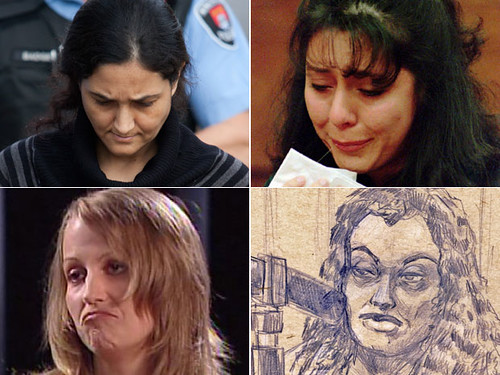
Clockwise from top left:
Tooba Mohammad Yahya, Lorena Bobbitt, Melissa Lewis, Karla Homolka


Weeping women just as capable of evil as men 
By: Christie Blatchford
November 14, 2011
The National Post
It was during a break one day in court in Kingston this week, after accused killer Tooba Mohammad Yahya had been sobbing up a storm, that I grunted to a colleague that I was weary of weeping women. 

Sunday, February 26, 2012

'I just wanted him to go to sleep'


"I just wanted him to go to sleep."

Christie Blatchford
Thursday, July 5, 2007
The Canadian Press

MEDICINE HAT -- The youth criminal justice system may have treated her as a victim, but the 13-year-old girl accused in the slaying of her entire family yesterday revealed the much sterner stuff of which she is made.

In cross-examination by prosecutor Stephanie Cleary, the girl, who can be identified only as "J.R.," was by turns testy, chirpy and spirited as she admitted she "might have" asked her boyfriend to kill her family for her, but she said the request would have been made sarcastically, "like, please, would you help me ... I was, like, never, 'Ohhh, this is a good idea.' "

She even allowed that she and the boyfriend discussed in these faux-murder hypotheticals that her brother couldn't be allowed to live, but said it was always done "in a stupid, joking, not-serious way."

The small courtroom was packed with "Hatters", as the residents of this small southeastern Alberta city call themselves, to hear the jarring juxtaposition of familiar teenage cadence applied to a discussion, even an allegedly joking one, of familicide.

And though the girl stuck tenaciously, if often inaudibly, to her denial that she and Jeremy Steinke had jointly planned the slaughter, she placidly agreed that she tried to choke her terrified little brother and stopped only when he began clawing at her arm.

"He was totally panicking," she said in her breathy low voice. "I was totally panicking. I just wanted him to go to sleep."

"But you were squeezing anyway?" Ms. Cleary asked.

"Yes," said the girl.

"You were squeezing his airway?"

"Yes," the girl said.

"He was fighting you, wasn't he?" Ms. Cleary pressed.

"Yes," the girl coolly replied, not a flicker of emotion crossing her face, eyes glittering like marbles.

By her version of her brother's death, moments after trying to choke him, at Mr. Steinke's shouted urging she stabbed the eight-year-old once in the upper body before Mr. Steinke allegedly snatched the knife from her and slit the boy's throat as she was backing out of his purple-painted bedroom littered with toys and games.

Both she and Mr. Steinke, then 12 and 23 respectively, are charged with three counts of first-degree murder, but he has yet to get a court date.

If the evidence at her trial has painted Mr. Steinke as the actual killer, this pony-tailed girl little more than half his age has emerged as the stronger-minded and arguably as the one calling the shots.

It was she who raged to anyone who would listen, but particularly to Mr. Steinke, who was besotted with her and pledging undying love in flowery poem, song and note, that she hated her parents and wanted them dead.

It was she who appeared, in Web chat that is now evidence in the case, to be wielding sex as a weapon over Mr. Steinke, once telling him, "I want to bang you," and according to one of his friends who testified here, threatening to break up with him if he didn't get the job done soon. By her testimony, they first had sex a week before the slayings, and again hours afterwards.

And it was she who, in love letters written after their arrest, was urging Mr. Steinke in essence to move on and advising him that whatever he said to anyone, even a psychiatrist, "can be used against you! For @#%$'s sakes! Rawr!"

Although she wept in court the first time she described her brother's last moments, and grew red-faced doing it a second time yesterday; although her lawyer, Tim Foster, two days ago drew out of her in careful questioning akin to pulling teeth her claim to blame herself ("it was my fault...'cause if I hadn't said those things, it wouldn't have happened"), there is on the evidentiary record here not one spontaneous expression of regret.

Yet the justice system has struggled from Day 1 to see the girl as anything other than a victim.

When Medicine Hat Police first arrived at her family's blood-spattered home and made their grim discovery, they spotted family pictures and noticed there was, as one of the officers testified, "a little girl," too, of whom they had seen neither hide nor hair.

The police searched the house again, checking closets (and discovering in one the little boy's pet hamster in a cage) to no avail: They believed the girl had been kidnapped and was in danger, and considered calling an Amber Alert.

Only later that night, after they discovered in the girl's school locker a cartoon of three members of a family of four being burned alive while the fourth merrily fled to a vehicle conveniently labelled as "Jeremy's truck," did they even begin to consider her a suspect.

The girl described that drawing as her regular "venting" of her fury against parental restrictions in a different form.

Indeed, she even referred Ms. Cleary to what a psychologist told her just days after her arrest.

The prosecutor was taking the girl through the long list of things she might have done that day, and didn't - from calling 911 to asking Mr. Steinke to stop, to sending her brother out the back door to get police, to protecting him herself.

"You didn't even try to save him, did you?" she asked.

The girl grew teary. "I was really scared," she whispered. "I thought he was going to try to kill me."

Yet by her own evidence, Mr. Steinke's first words, as he staggered upstairs, covered in blood and panting, were, "I love you. I love you." When he began yelling at her to stab her brother, the girl said she understood him to mean that he had killed her parents for her, and now she had to do this.

But the little boy was supposed to die all along, Ms. Cleary said, wasn't he? "That was the plan, wasn't it?"

"There wasn't a plan," the girl said, eyes filling up.

But if Mr. Steinke had done something "you never wanted, you never asked him to do, which surprised and shocked and horrified you," why then did she accept his jailhouse marriage proposal made just days later?

"My psychologist said it was post-traumatic stress disorder," the girl replied smartly, eyes clear now, mouth turning up just a touch at the corners.

She'd been in custody only four days at that point, and already the system was beginning to teach her the very lesson she learned so well: She'd been involved with a bad man and exposed to a bad thing, poor lamb.

The evidence in the case is complete. Lawyers will make their closing arguments tomorrow, with the judge charging the jury on Monday.


Saturday, February 25, 2012

Tearful Confession Evokes Homolka's Grisly Deed


Tearful confession evokes Homolka's grisly deed

By Christie Blatchford
Wednesday, July 4, 2007
The Canadian Press

MEDICINE HAT -- Perhaps not since Karla Homolka described the drugging and handing over of her younger sister as a Christmas present for her then-serial-rapist boyfriend Paul Bernardo has a Canadian jury seen and heard such a galling confession.

The 13-year-old girl accused in the slayings of her entire family took the witness stand in her own defence here yesterday to describe her little brother's last minutes, the boy mewling, calling her name and looking to her for help - and how his cries fell on her deaf ears.

Cut through her myriad tearful explanations - she was panicking, she feared for herself - what the girl admitted doing was first putting the eight-year-old's neck in a half-Nelson, nearly choking him, and then stabbing him once in the upper body.

An autopsy revealed the boy had been stabbed four times, twice in the face and twice in the chest, and had the pinpoint hemorrhages of the eyes and mouth commonly seen in strangulation. But he died of a 12-centimetre-long gash to his throat.

He weighed only 68 pounds and stood 4 foot 4.

The two cases have something else in common beyond the moral failure to protect a vulnerable younger sibling.

As Ms. Homolka impatiently justified her conduct at Mr. Bernardo's murder trial by saying that the idea was that Tammy would be drugged and raped just "the once" (alas, she choked on her own vomit and died), this girl told the jurors that she could bring herself to stab her brother only once, and not very deeply at that.

Both the woman and the girl, who was 12 years old at the time of the slayings and can only be identified as J. R., blamed their male partners.

According to the girl's version of events, she and her brother were cowering upstairs in the house, listening first to her mother's screams and then her father's desperate struggle for his life with her then-23-year-old boyfriend, Jeremy Steinke.

The little boy cried that he was scared, and his big sister offered a peculiar comfort: "I put the crook of my elbow around his neck and I squeezed," she said. "I was trying to make him go to sleep because it was horrible. I didn't want him to hear it."

But the boy cried: "What are you doing, [J. R.]? Stop, stop!"

She did, but any reprieve was short lived.

Shortly afterward, she said, Mr. Steinke staggered upstairs, covered in blood, panting his love for her. He spotted the kitchen knife in her hand, which she ostensibly had retrieved from her bedroom for self-defence, and yelled at her to stab the boy. "Stab him! Just stab him! Slit his throat!" she said he screamed.

"I can't," she said she told him. "I can't do it."

"You have to do this," Mr. Steinke told her. "I did this for you!"

"He was getting really, really mad," the girl said in her oft-inaudible soft voice. "I was panicking that he was going to hurt me.

"I stabbed my brother."

During this part of her testimony, elicited by her lawyer Tim Foster in a gentle manner straight out of a counselling session - "How did you feel about that?" he would often ask, like a friendly psychiatrist - the girl was weepy, red-faced, plucking at the folds of her smocked blue top and occasionally burying her face in her hands. Mr. Foster began to probe this turf by saying, "Let's talk about Jeremy, cause that's what we're kind of all here about."


In fact, this is the girl's murder trial; Mr. Steinke, facing the same three charges of first-degree murder, has yet to get a court date.

But for most of the rest of her day-long evidence, she was cheerful, often flashing a big white grin as she was led down memory lane by her lawyer. Her whispered mumbling, coupled with the teenager's penchant for turning every sentence into a question, had Mr. Foster, the judge, court reporter and even jury members variously begging her to speak up.

According to her, Mr. Steinke snatched the knife from her, and as she fled the room, her brother crying "[J. R., J. R.], I'm scared," she saw Mr. Steinke make a sweeping motion: "He slit his throat."

From the doorway of her parents' bedroom down the hall, "I heard my brother trying to breathe," she said. "It was gurgling."

Her professed fear of Mr. Steinke notwithstanding, the girl immediately fled after him to his trailer, and then to a friend's flat, where they had sex. "He pulled me on top of him and started kissing me," she said. "How did you feel about that?" Mr. Foster inquired solicitously.

"I didn't feel like anything was real," the girl said. "I was like so out of my mind, I couldn't really process what happened, I didn't want to think about it."

"Why did you go to Jeremy's?" Mr. Foster asked.

Too young to have heard the old joke about the child who kills his parents and then throws himself upon the mercy of the court as an orphan, she whispered, "Because he was the only person left that loved me and I knew he'd take care of me and I'd be safe with him."

Later, she offered a variant of this when asked to explain why she continued to write him after their apprehension, even accepting his jailhouse marriage proposal: "I needed to love him because I felt he was the only person left."

Several times, Mr. Foster asked if she had been able to cry about what the two of them yesterday came to call, in the passive voice others might describe tornados or acts of nature, "these things that happened."

"No," she said once, "this is too big to cry about." Another time, when he asked, "Were you able to cry about this?" she said she thought she'd cried the day she and Mr. Steinke were arrested across the border in Saskatchewan.

The girl's testimony confirmed other evidence heard earlier at the trial - that she had remarked to friends a day later that her brother had been "gargling" (she said it, she told the jury, to shut up Mr. Steinke's bragging); that the two of them had talked about killing her parents but only as "stupid talk" and what she called "hypotheticals" and never for a minute meaning it; that she was raging about the restrictions they put on her.

As for a stick drawing she did, portraying the burning alive of three members of a four-member family rather like her own, she said it was but another example of her "venting."

"I was angry," she said. "I was venting, heh-heh." She drew it in band class one day in late March, she said. "I guess I put it in my locker and forgot about it. It was a different way of venting ...."

Police found it in her locker on April 23 last year, the day the bodies of her parents and brother were discovered.

She seemed most outraged yesterday when Mr. Foster asked her if she had ever seen the "N word" on Mr. Steinke's page of dislikes on a website where they were both members.

"We had a conversation about that," she replied smartly, quite audibly for once. "I was mad at him for that."

A thoroughly modern girl, then: On her own profile on that website, her own dislikes list began, "Homophobia, ageism, sexism, hypocrites ..." Stabbing a little brother, choking him, listening as he fought for breath through a gash in his throat, are not so bad as all that.